


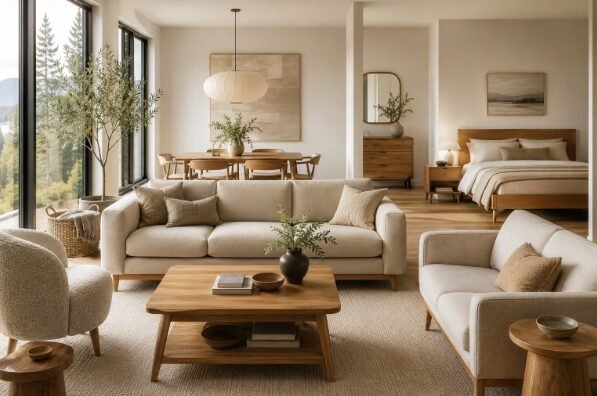
Most first-time homeowners start with a rough idea and end up either buying too fast, spending in the wrong places, or furnishing room by room with no connecting logic between them. The result is a home that is ‘functional’ but never quite feels pulled together.
This post is a furniture buying guide for Canadians who want to get it right from the start with the right pieces, in the right order, chosen with enough thought that you are not replacing them in two years.
Start with a Budget Allocation, Not a Shopping List
Before building a furniture list for home, divide your budget by room and prioritize the spaces you will use most. For most households, that means the bedroom and the living room first, then the dining area, then everything else.
A reasonable benchmark for new Canadian homeowners is allocating 10 to 15 percent of the home’s purchase price toward furnishings across the first year. That does not mean spending it all at once. It means having a ceiling so individual purchases stay proportional to the whole.
Buy fewer pieces and buy them better. A solid wood dining table bought once at a considered price point will outlast three budget replacements and cost less overall.
How to Choose Furniture for a New Home: The Living Room
The living room is where how to choose furniture for a new home becomes most personal, because it is the room that sets the tone for everything else.
Start with the sofa. It is the largest visual anchor in the space and the piece that everything else responds to. Choose a profile and fabric that suits how the room will actually be used: a performance fabric for households with pets or children, a textured weave or boucle for a more considered aesthetic in a quieter home.
Beyond the sofa, a loveseat is worth considering in any living room that needs flexible seating without the bulk of a second full sofa.Hygge Design House’s loveseat collection carries options that sit naturally within Scandinavian and Japandi-influenced interiors: compact proportions, warm upholstery, and clean lines that work alongside a main sofa without competing with it.
Decorating tips for the living room that hold across every style:
- The sofa and main seating should face each other or share a focal point, not float independently in the room
- A coffee table or ottoman should sit 40 to 45 centimetres from the sofa edge, close enough to reach without leaning
- A rug should be large enough that at least the front legs of all major seating pieces rest on it
The Bedroom: Where to Spend and Where You Can Save
The bedroom is the room most first-time homeowners underspend on, and the one they most regret underinvesting in six months later.
The furniture list for home for a bedroom starts with the bed frame and mattress. These two purchases affect sleep quality, which affects everything else. A low-profile platform bed frame in solid wood is the right starting point for a modern Canadian bedroom: no box spring required, clean silhouette, and a design that suits both Scandinavian and Japandi aesthetics equally well.
After the bed: a nightstand on each side, a dresser with enough storage to keep the room clear of clutter, and a bench or chair at the foot of the bed if the room has the space. An accent chair in a bedroom corner does more for the feel of a room than most people expect. It turns a functional room into one that feels considered. Hygge’s accent chair collection is a strong place to look for pieces with the right balance of warmth and restraint.
The Dining Room: Proportion Matters More Than Style
The most common dining room mistake is buying a table that is too small for the room or too large for the number of people who will regularly use it.
A rectangular table suits most Canadian dining rooms. As a rule, allow 60 centimetres of clearance between the table edge and any wall or furniture behind the chairs so people can push back and stand comfortably. For a household of two with occasional guests, a table that seats four comfortably and extends to six is the most practical choice.
Dining chairs should be comfortable for longer meals, not just aesthetically considered. Upholstered seats make a meaningful difference to how long people stay at the table, which in a home built around warmth and gathering is entirely the point.
How to Decorate Your First Home Without Starting Over Again in Three Years?
How to decorate your first home well comes down to one principle: build around neutral foundations and layer in warmth through texture and natural materials.
Choose furniture in warm wood tones, natural linen, and muted upholstery. These pieces do not date themselves. A sofa in warm oat or a bed frame in white oak reads as considered in 2026 and will read the same way in 2031. The Japandi and Scandinavian design principles that inform this approach are built on exactly this: objects chosen for their quality and their calm, not for their moment.
Canadian made furniture is worth prioritising where possible. Beyond supporting domestic manufacturing, Canadian-made pieces are often built to handle the country’s climate, specifically the humidity shifts between seasons that cause cheaper imported wood furniture to warp or loosen at the joints over time.
The Furniture Buying Guide Summary: What to Buy First
For a first-time homeowner working through rooms in order of priority:
- Bedroom: Platform bed frame, quality mattress, two nightstands, dresser
- Living room: Sofa, loveseat or accent chairs, coffee table, rug
- Dining room: Dining table sized to the room, four to six chairs
- Secondary pieces: Storage, bedroom bench, additional lighting
Take your time with the secondary pieces. The foundational items are what shape how the home feels. A well-chosen sofa, a solid bed frame, and a dining table with real presence will carry the home through years of change and shifting tastes without ever feeling out of place.
For pieces that sit within a warm, Scandinavian-inspired aesthetic without compromising on quality or design.Hygge Design House is worth exploring early in the process, before the budget has been spent in the wrong places.